Study Suggests Dante’s “Inferno” Described a Planetary Impact


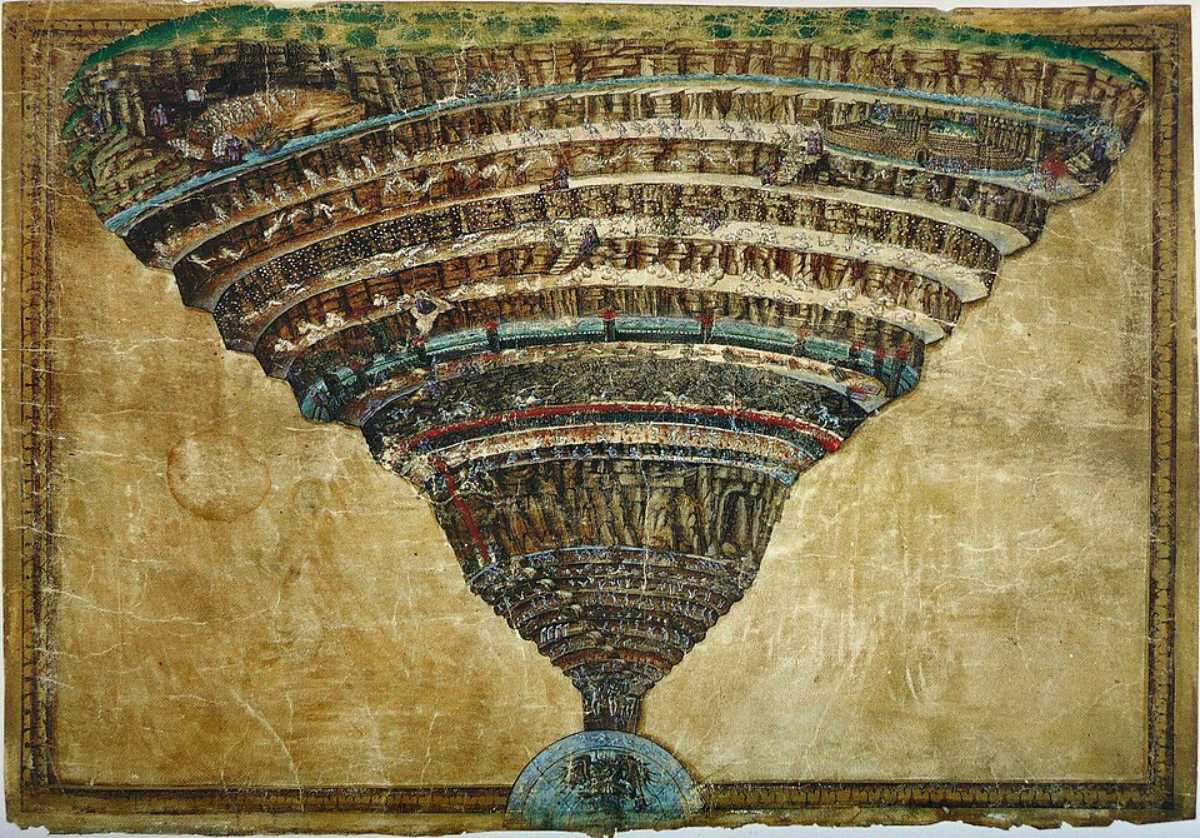
A study presented at the General Assembly of the European Geosciences Union (EGU) in Vienna suggests that the structure of Hell described by Dante Alighieri in the “Divine Comedy” bears similarities to complex craters formed by asteroid impacts. The research was led by Iain Stewart of the University of Plymouth and proposes that the Italian poet may have depicted, in the 14th century, geological features that would only be formally described by science about 500 years later.
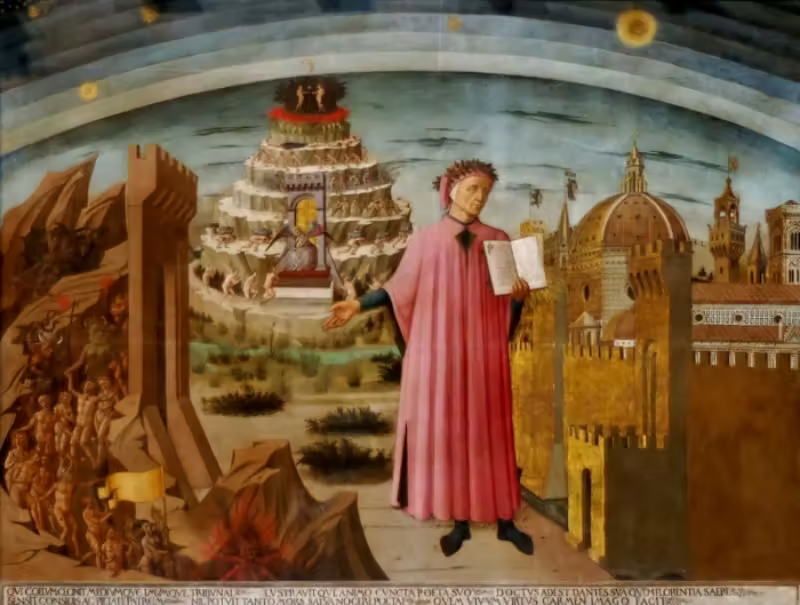
In “Inferno,” Dante describes the underworld as a massive inverted cone beneath the Earth’s surface, divided into nine concentric circles that narrow toward a frozen core. According to the researchers, this geometry resembles what planetary science defines as a “complex impact crater,” formed after collisions with large asteroids.
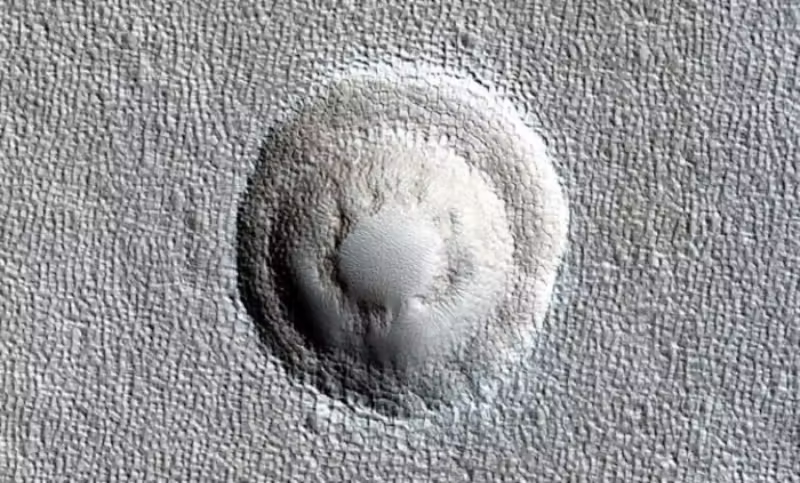
These craters typically feature terraced inner walls, a central uplift, and a broad inner basin. According to the study, these elements correspond “remarkably closely” to the spatial configuration described by Dante.
The authors argue that the Florentine writer was influenced by medieval natural philosophy, rooted in thinkers such as Aristotle and by Arab scholars who preserved and transmitted classical knowledge to medieval Europe.
The hypothesis presented at the EGU does not claim that Dante possessed modern scientific knowledge of planetary impacts. Instead, the central argument is that physical and geometric concepts present in the philosophical traditions of the time may have led the author to create a representation consistent with real geological structures.
The study highlights the Chicxulub crater in particular. Formed around 66 million years ago by the asteroid linked to the extinction of the dinosaurs, it is considered one of the most extensively studied impact craters on Earth.
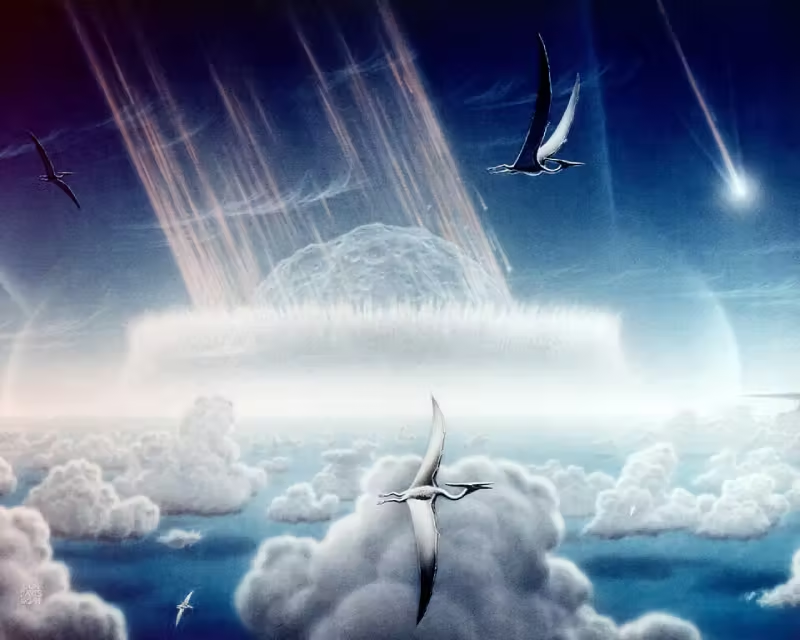
According to the researchers, features such as Chicxulub’s elevated central ring, terraced walls, and inner basin provide a modern parallel to Dante’s description of Hell.
The research also notes that the scale of the Inferno described in the “Divine Comedy,” comparable to the size of the Mediterranean basin, would be consistent with large-scale terrestrial impacts. The authors, however, acknowledge that this may simply be coincidental.
The work was presented during the EGU General Assembly, one of the leading international gatherings in the fields of geoscience and planetary science. The study has not yet been published in a peer-reviewed scientific journal, and the researchers themselves describe the hypothesis as speculative.
The proposal is part of a broader line of research exploring possible natural knowledge preserved in ancient and medieval texts. Previous studies have examined astronomical interpretations linked to archaeological sites such as Göbekli Tepe and mythologies associated with cosmic impact events.
For Stewart and his team, the significance of the hypothesis lies less in historical proof and more in the convergence between literary imagination, medieval natural philosophy, and modern concepts in planetary geology.
Quer continuar acompanhando conteúdos como este? Junte-se a nós no Facebook e participe da nossa comunidade!
Seguir no Facebook