CIA mentions alleged temple beneath the Sphinx in 1952 file


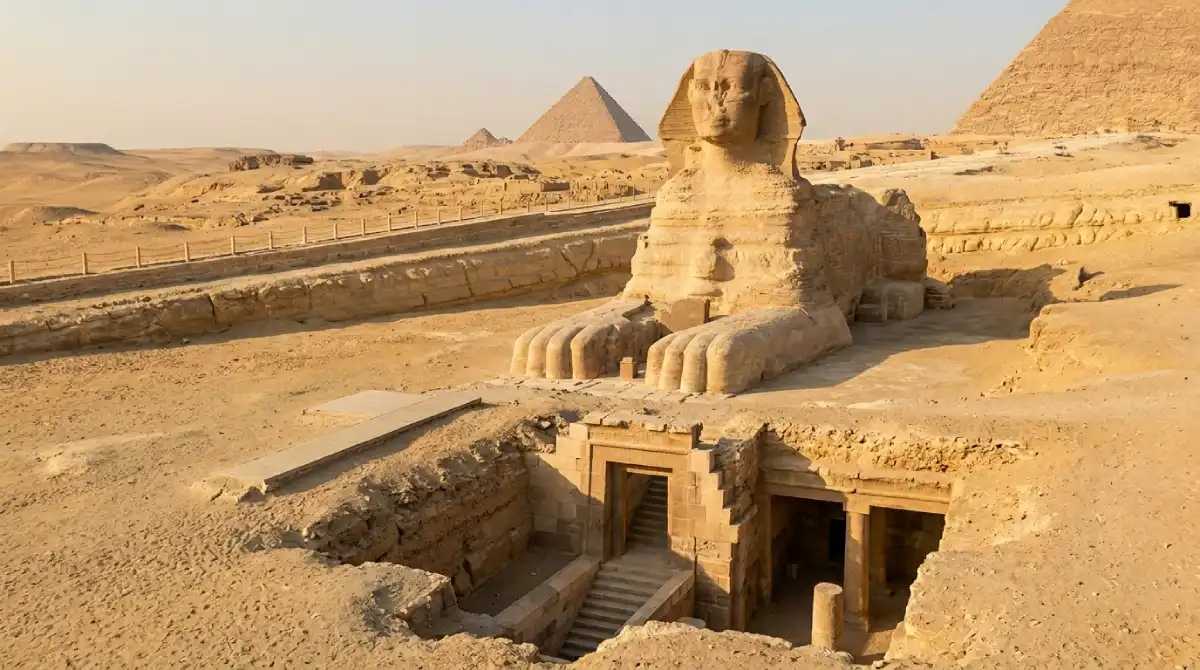
A declassified CIA document has reignited debates about possible underground structures in the area surrounding the Great Sphinx of Giza in Egypt. The file, produced in 1952 and released to the public in 1999, directly references a “temple beneath the Sphinx,” a phrase that has once again circulated in alternative history and archaeology forums.
The document, identified by the code CIA-RDP83-00423R0001000200001-7, consists of an internal form used to catalog photographic material. The record lists 11 rolls of black-and-white negatives captured between July and December 1950 in various areas of the Middle East and Central Asia.
The passage that sparked the greatest interest appears in entry number 15 of the inventory. Dated July 1950, the description mentions a photograph titled “Temple under Sphinx.” The wording differs from the traditional references to the so-called Sphinx Temple or Valley Temple, known structures located in front of the monument rather than beneath it.
The mention revived theories linked to American psychic Edgar Cayce, who in the 1930s claimed that an underground library existed beneath the Sphinx’s right paw. The alleged chamber was said to be connected to a lost civilization frequently associated with the myth of Atlantis.
Supporters of these theories argue that the terminology used by the intelligence agency could indicate the existence of records concerning underground structures later dismissed by conventional archaeology. However, the declassified document does not include the original photographs — only the cataloged titles — making it impossible to verify the referenced content.
The file also contains other descriptions considered unusual. In entries 11 and 12, there are references to a “rotating mechanism” in Baalbek, an archaeological site known for its massive Roman-era megaliths. As in the case of the Sphinx, no images are available for public analysis.
Mainstream archaeology remains skeptical about the existence of hidden chambers beneath the Sphinx. Egyptologist Zahi Hawass has stated on several occasions that the area has been extensively investigated without any evidence of a so-called “Hall of Records.”
According to Hawass, research conducted alongside archaeologist Mark Lehner in 1979 concluded that the region beneath the monument consists only of solid bedrock. Later excavations and geological surveys also failed to identify structures consistent with the popular theories.
Even so, the document has once again gained traction on social media and within communities dedicated to alternative history.
Independent researchers such as Trevor Grassi and Adriano Forgione argue that the use of the phrase “beneath the Sphinx” in an official CIA record raises questions about possible undisclosed information involving the Giza Plateau.
Quer continuar acompanhando conteúdos como este? Junte-se a nós no Facebook e participe da nossa comunidade!
Seguir no Facebook