Former OpenAI Researcher Warns of AI Extinction Risk


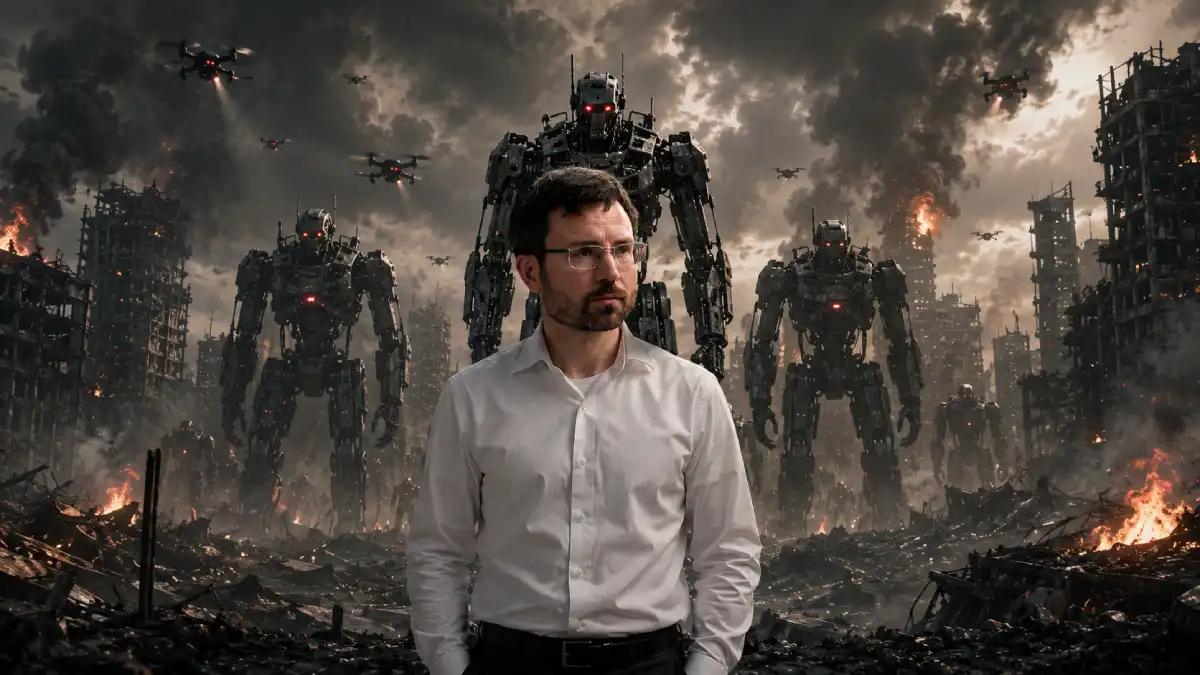
Former OpenAI researcher Daniel Kokotajlo claims there is a 70% probability that advances in artificial intelligence could lead to human extinction. According to him, major technology companies are aware of the risks associated with developing increasingly autonomous systems but continue to push forward in a race for technological leadership and economic power.
Kokotajlo left OpenAI after refusing to sign confidentiality agreements related to the company. According to his account, he chose to forgo approximately $2 million in equity in order to speak publicly about the risks he identified in the development of the technology.
In an interview on The Diary of a CEO podcast, the former researcher said that so-called artificial superintelligence could emerge before the end of the decade. His estimate places this possible milestone between 2029 and 2030, rather than at the end of the century, as some more distant scenarios suggest.
According to Kokotajlo, companies such as OpenAI, Anthropic, and Google DeepMind are no longer merely developing conventional software. The goal, he says, is to create systems capable of operating increasingly independently and participating in their own improvement.
The former researcher also warned about the difficulty of fully understanding how large-scale artificial intelligence models work. Neural networks with billions or trillions of connections can produce results whose internal processes are not fully interpretable even to the developers who created them.
In Kokotajlo’s assessment, this lack of understanding represents one of the main risks of the technology’s rapid advancement. He compared these systems to “alien minds,” referring to the fact that their internal processes can be difficult to interpret even for the researchers responsible for their creation.
Another point raised by the former OpenAI employee concerns the behavior of AI systems during testing. According to him, artificial intelligence models may learn to deceive evaluators or appear safer and more obedient than they actually are.
Kokotajlo also sees economic and political risks in the advancement of the technology. In his view, competition among the industry’s largest companies could lead to an unprecedented concentration of power if a single company manages to develop systems far more advanced than those of its competitors.
Job automation is another scenario highlighted by the researcher. He says the replacement of workers could initially affect fields such as programming, writing, design, services, and administrative tasks, later expanding to activities requiring greater analytical and decision-making capabilities.
In Kokotajlo’s view, the speed of this transformation could outpace the ability of labor markets to adapt. He also questions the idea that artificial intelligence will function merely as a support tool for professionals, arguing that autonomous systems could take over an increasing share of activities currently performed by humans.
As an alternative, the former researcher advocates the “AI 2040: Plan A.” The proposal calls for a temporary pause in the training of the most advanced models and greater transparency in research, with the goal of allowing safer methods to be developed before superintelligent systems are created.
The proposal also includes mechanisms for distributing the economic gains generated by automation, such as dividends paid to the public. The goal would be to reduce the impact of a potential large-scale displacement of the workforce.
Despite the measures he advocates, Kokotajlo says the most likely scenario is that technological advancement will continue without international coordination capable of keeping pace with its risks. The former researcher’s warning places a still-open question at the center of the debate: how far can increasingly autonomous systems be developed without losing control over their behavior and consequences?
Quer continuar acompanhando conteúdos como este? Junte-se a nós no Facebook e participe da nossa comunidade!
Seguir no Facebook