
Second Sphinx may be buried in Giza


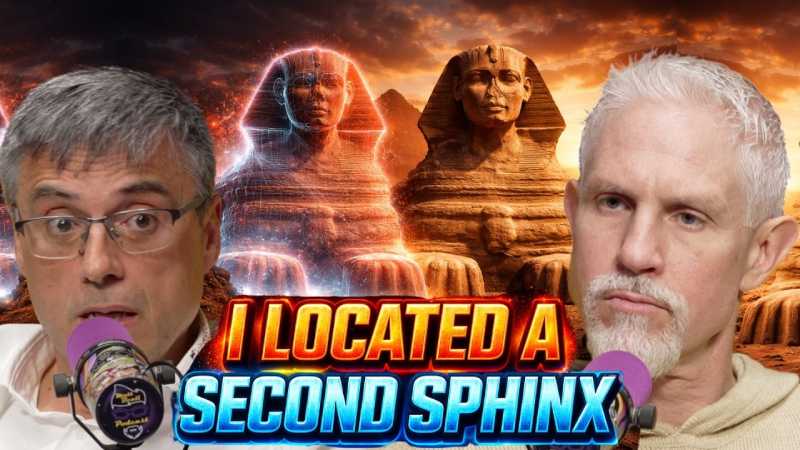
An Italian researcher claims to have found evidence of a second Sphinx buried beneath the sands of the Giza plateau in Egypt.
The person behind the discovery is Filippo Biondi, the same scientist who had previously identified underground structures beneath the pyramids of Giza Plateau. This time, he used synthetic aperture satellite radar—a technology capable of “seeing” beneath the ground using microwave signals—to map the region. The results were presented on Matt Beall Podcast.
What the radar images revealed
The data points to a large underground structure with striking symmetry in relation to the already known Great Sphinx of Giza. According to Biondi, the images show geometric anomalies and cavities that have no natural explanation.
“We mapped the first Sphinx, all the pyramids, the junction between the Sphinx and the Pyramid of Khafre, and we found vertical shafts and horizontal passages. This discovery shows a large void, a very long rectangular space,” the researcher said.
The structure is believed to be located in a mound near the Great Sphinx of Giza, in a position that aligns with geometric patterns previously identified in earlier studies by the same team.

Degree of confidence in the data
Filippo Biondi estimates the reliability of the data at 80% and made it clear that he intends to collaborate with other specialists before drawing definitive conclusions. Regarding the possibility that the structure may be hollow inside, he was direct: “Probably yes. Our intention is to bring in other experts to work with us and find out what lies beneath.”
What ancient Egyptian history had already suggested
The idea of a second Sphinx is not new among scholars. The Dream Stele, positioned between the paws of the Great Sphinx of Giza during the reign of Thutmose IV, depicts two leonine creatures back-to-back—something that has long led researchers to suspect that the Sphinx was not an isolated monument, but part of a symmetrical complex.
The stele itself recounts that Thutmose IV, still a prince at the time, fell asleep beneath the head of the Great Sphinx of Giza during a hunt. According to the text carved into the stone, the Sphinx promised him the throne of Egypt in a dream if he removed the الرمال covering it.

What would change if the discovery is confirmed
If excavations confirm what the radar is suggesting, we could be facing one of the greatest archaeological milestones of the 21st century. The find would not only change the appearance of the Giza Plateau—it would also force historians to rethink the rituals and architectural designs of ancient Egyptian builders.
For now, what exists are promising data and a well-supported hypothesis. The final word, as always in archaeology, will depend on what is actually uncovered once excavations truly begin—and the whole world will want to know what lies beneath those ancient sands.
Quer continuar acompanhando conteúdos como este? Junte-se a nós no Facebook e participe da nossa comunidade!
Seguir no Facebook