Avi Loeb and Beatriz Villarroel disagree about lights from the 1950s


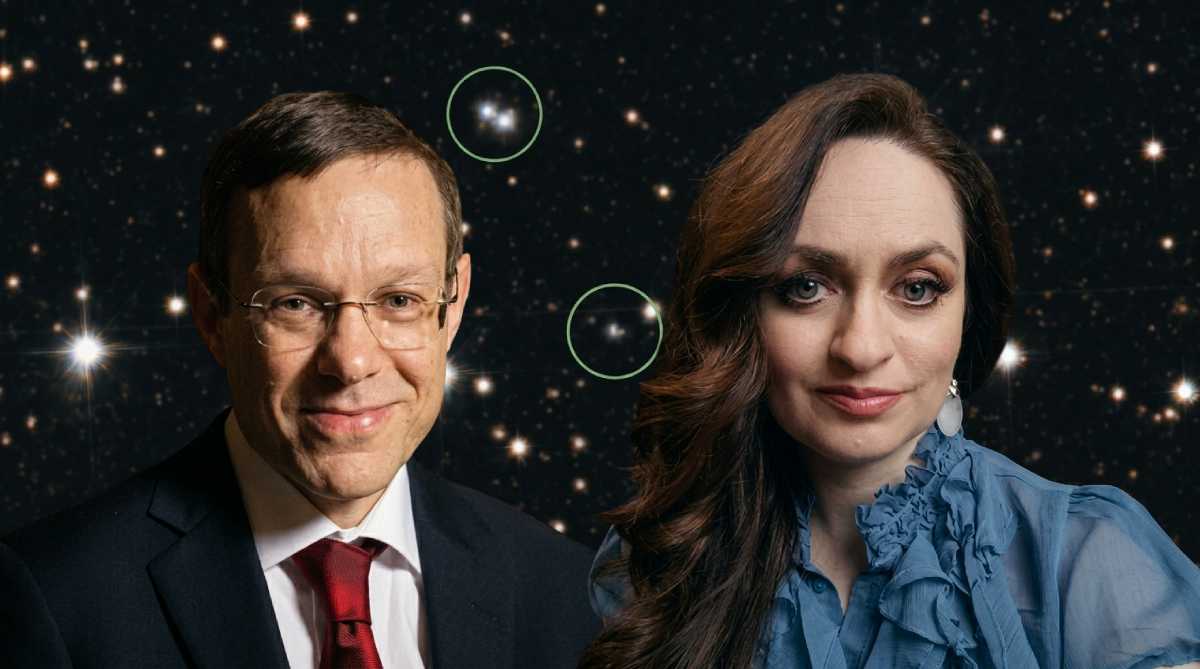
Avi Loeb and Beatriz Villarroel are at the center of a scientific debate over luminous points recorded on photographic plates from the Palomar Sky Survey during the 1950s. The images were captured before the launch of the first artificial satellite and have once again become a focal point in discussions about possible unidentified anomalous phenomena.
Avi Loeb published an analysis arguing that the signals may be explained by cosmic ray impacts on the photographic emulsions used at the time. According to the researcher, energetic particles striking the plates at a nearly perpendicular angle could produce small bright spots without leaving linear trails.
The scientist compared the effect to reports from astronauts during the Apollo 11 Moon Landing. During the 1969 mission, Buzz Aldrin described flashes observed inside the spacecraft cabin, which were later linked to cosmic rays impacting the human retina.
Based on calculations involving the exposure time of the photographic plates, Loeb estimates that each image could have received tens of thousands of particle impacts during roughly one hour of observation. In his view, this would naturally explain the presence of multiple transient points without the need to invoke the hypothesis of objects of non-human origin.
The researcher also raised the possibility that particles released by atmospheric nuclear tests may have influenced some historical records. According to Avi Loeb, this hypothesis could help explain the frequent associations made between unidentified anomalous phenomena and nuclear activities during the last century.
The interpretation, however, is disputed by Beatriz Villarroel, who leads the VASCO project. The researcher argues that the cosmic ray model does not account for specific patterns identified by the team across different sets of historical data.
Among the arguments presented is the absence of luminous points in regions corresponding to Earth’s geometric shadow at an altitude of about 42,000 kilometers. According to Beatriz Villarroel, cosmic particles dispersed through the atmosphere would not produce a distribution consistent with this pattern.
The team also identified an anticorrelation with geomagnetic storms. Under the cosmic ray hypothesis, an increase in occurrences would be expected during periods of greater solar activity, but the analyzed data instead appear to show a reduction in these events.
Another point raised by the researcher is that the signals seem to avoid the plane of the ecliptic, the region of the sky where most bodies in the Solar System are concentrated. In her view, this behavior does not match the expected pattern of a homogeneous bombardment by subatomic particles.
The debate gained attention beyond academic circles following public statements by explorer Dennis Asberg, who is associated with Beatriz Villarroel’s project. He defended the methodological rigor of the research and criticized approaches viewed as dismissive toward the study of anomalous phenomena.
Avi Loeb argues that modern observatories may ultimately settle the debate. The researcher points to the 3.2-gigapixel camera of the Vera C. Rubin Observatory as an instrument capable of detecting possible transient objects with far greater precision than was available in the 1950s.
Despite attempts at conventional explanations, the exact origin of the historical records remains undefined. Some researchers believe the data still require further investigation before any conclusion can be reached regarding the nature of the lights detected on the old astronomical plates.
Quer continuar acompanhando conteúdos como este? Junte-se a nós no Facebook e participe da nossa comunidade!
Seguir no Facebook